
A Decade of Rustls
2026-09-08 — Joe Birr-Pixton
This year marks ten years of Rustls. In this post, we reflect on a decade of the project: where it started, how it has grown, and where it's heading next. This post is based on our presentation at RustConf 2026.
The early days
Rustls began with a first commit on May 2, 2016. Progress was quick: a month later, on June 5, it could interoperate with most sites on the web. The first release, 0.1.0, followed on August 27, 2016 – less than four months after the first commit.
Early on, there were significant external contributions from @briansmith and @djc.
In 2018 @djc and @Ralith contributed QUIC support to rustls during the development of Quinn; this was the first outside contribution of a significant feature. In 2021 @djc became the first co-maintainer, and was joined by @cpu in 2023.
Between 2018 and 2020 @djc worked towards arranging a third-party audit which was funded by CNCF at the request of Buoyant.io and completed by Cure53. In 2021 the project had its first paid contributions, where @djc was under contract with ISRG via their Prossimo initiative to work on robustness. Later on, Prossimo funded myself, @cpu, @djc and others to dramatically improve the pace and depth of development.
That funding helped us deliver significant features -- pluggable cryptography providers, no_std support, FIPS certification, post-quantum key exchange and Encrypted ClientHello -- as well as sibling projects like rustls-platform-verifier and the OpenSSL compatibility layer.
Releases up to 0.23
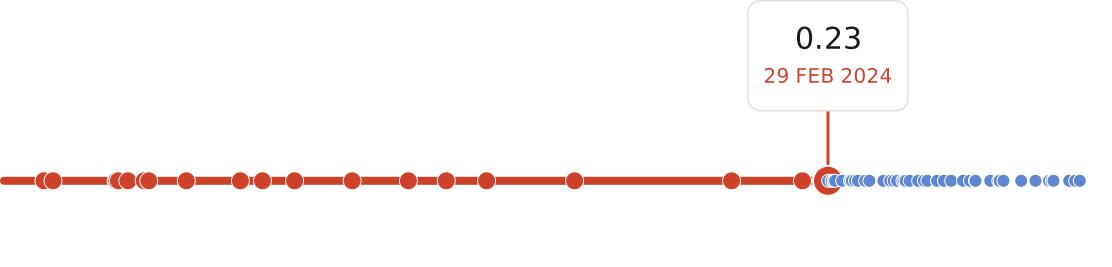
From the 0.1.0 release, the project moved through a long series of releases over the following eight years, building out functionality, hardening and refining the API. That sequence of release lines culminated in 0.23, released on February 29, 2024.
The 0.23 line: stability and features
The 0.23 release line has been a stable one: in the time since, it has seen 43 non-breaking releases. That stability didn't come with stagnation. The 0.23 line delivered a wide range of important features, including a FIPS-certified cryptography option, certificate compression, Encrypted ClientHello, post-quantum cryptography, and performance improvements.
The present: 0.24
The next breaking release is 0.24. It brings many improvements, amongst them:
- External buffering, improving bulk data performance
- Some support for async-friendly usage
- "Split mode"
- New arrangements for choosing a
CryptoProvider
External buffering and bulk data performance
In earlier releases, all data passed through std::io traits. This had a number of drawbacks: extra copies, awkward error handling, no no-std support, no half-close, and poor control over buffer sizes.
In 0.24, buffering moves outside Rustls. All TLS input arrives through a new trait, TlsInputBuffer, and all TLS output is appended to a user-provided &mut Vec<u8>. Incoming plaintext is decrypted in place and returned as a borrow into the input buffer, avoiding copies. Two implementations of TlsInputBuffer are provided: SliceInput and VecInput. VecInput can read from an io::Read, as before, giving a route to easy porting.
Async-friendly usage
For some time, we've been waiting on Rust language developments — async dyn traits and "async keyword generics" — before addressing async usage directly. Rather than wait longer, 0.24 introduces a system of session types that model the steps of the handshake process. Servers move through NeedsInput → Accepted → VerifyClientIdentity → Complete; clients move through NeedsInput → VerifyServerIdentity → Complete.
Each step can be driven in async, blocking, or completion-based style. More steps can be added in the future in non-breaking changes. This replaces, and builds on, the Acceptor API seen in 0.23.
Split mode
Previously, a single Connection object was responsible for both sending and receiving data. In 0.24, post-handshake sending and receiving are handled by separate objects: SendTraffic and ReceiveTraffic. Both are Send, so they can be used on different threads. This means full-duplex workloads can now double their throughput. The two objects communicate through an internal back-channel with very low contention.
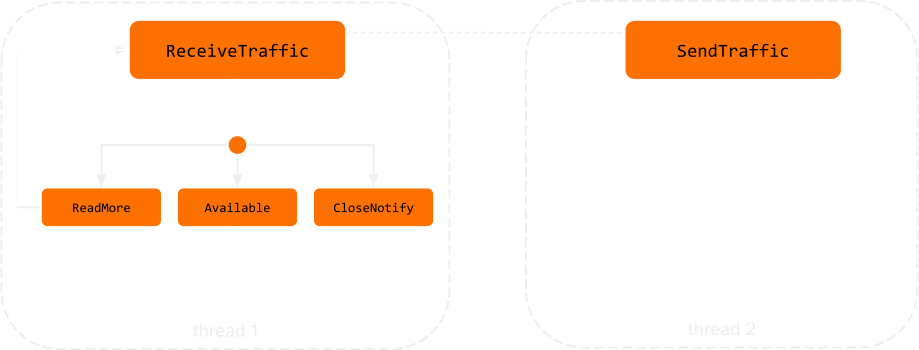
This is a feature first requested in 2019, and one we think is unique in TLS libraries. It will be exciting to see applications make use of this to take their TLS performance to the next level.
Choosing a CryptoProvider
All cryptography used by Rustls comes via a CryptoProvider. In 0.23, two providers were built-in and could be chosen by crate features. In 0.24, providers are separate crates, such as rustls-aws-lc-rs and rustls-ring, and the main rustls crate no longer has crate features for selecting a provider. Choosing a global provider at the top of main() now happens elsewhere. As a result, there are no more panics related to feature unification.
The future
After 0.24 is released, it will be baked for a little while to shake out any issues and give the ecosystem time to adapt. Then 1.0 will follow, and we want this to be a stable API that we can maintain long-term.